



Peter Lefort and I embarked upon the sprawling realms of complexity and ambiguity.
I found myself probing Peter about the "outputs" of his work – that classic "input-process-output" model. He’s tasked with extracting cutting-edge environmental and climate research from the academic ivory tower, translating it, and democratizing its reach. But, as he revealed, the real output isn't a neat, measurable deliverable. It's about fundamentally "changing what a university looks like in the future". We in academia, and perhaps many of us in general, carry an "understandable arrogance" that "we will provide knowledge" to fix problems. But as Peter reminded me, universities themselves "need to change as much as anything else." It's a truth that hits close to home for anyone who's ever clung to a familiar, seemingly robust, system.
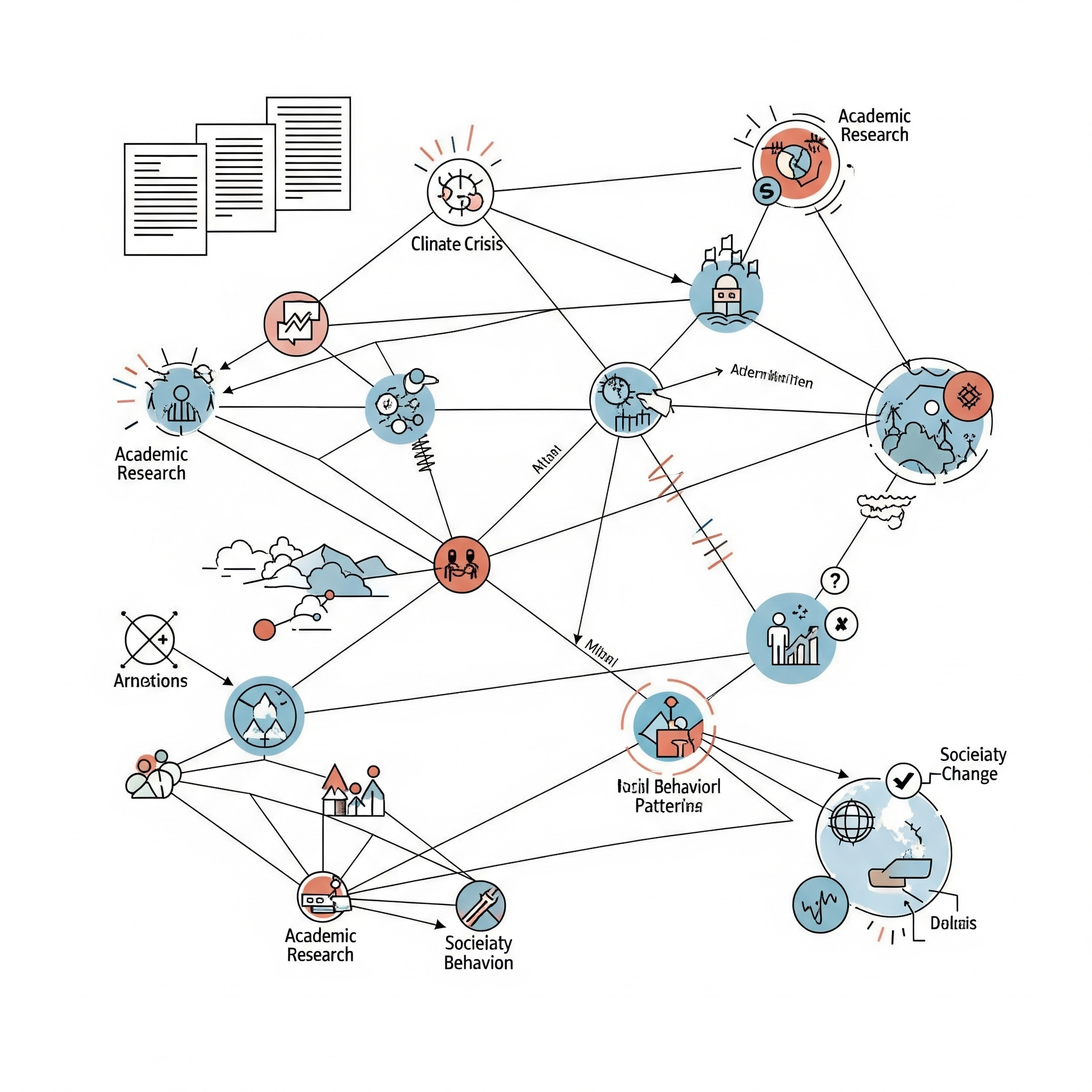
This led us to a crucial distinction that truly resonated with my own ongoing musings: the difference between complexity and complication. Peter offered a brilliant analogy: a bicycle is complicated – you can take it apart, fix it, it’s predictable. But put a human on that bike, and you have a cyclist – that’s complexity. You can't predict what they had for breakfast or the traffic; you need "multiple perspectives" because you can't "really control that system". So much of our climate crisis response, I realized, stems from treating "complex challenges as though they are complicated". My own mental shortcuts certainly prefer the neat predictability of a bicycle, rather than the wild ride of a human on it. 🚴♀️
The discomfort with ambiguity surfaced again when we discussed our inherent bias against admitting what we don't know. Like the Ellsberg paradox I’ve mused on before, we gravitate towards the definable. Universities, for a long time, were the comfortable "source of knowledge". But in these more complex crises, Peter asserts, "not only does a university not have the answers, there aren't answers to these questions, there are no right and correct answers." What's needed is to "hold space for that" and "speak to the human in people," acknowledging the raw emotions of fear, grief, and joy that get "left out of the kind of the complicated process." It's a humbling reminder that even with all our data, understanding the human heart in the system is paramount. ❤️
One of Peter’s key observations highlights a critical societal gap: accountability. We treat recurring crises like flooding or pandemics as "acts of God," reacting post-factum rather than building "accountability... baked into the system" proactively. COVID-19 showed us how institutions, once thought "intractable", could change "effectively overnight" when the mandate and power were aligned. The challenge is embedding that accountability before the crisis hits. 🕰️
The conversation deepened into the fascinating, yet precarious, realm of sociological tipping points. While ecological and technological tipping points are more "comfortable" to model, human behavior introduces layers of "even more complex" uncertainty. Peter's work explores not just pushing for change, but building the "scaffolding" for the desired new state, acknowledging the frightening possibility that simply reaching a tipping point could lead to an "even more kind of hardline fascist society" if the subsequent trajectory isn't also considered. It's a delicate balance of pushing the ball up the hill, while also building the right "tracks" for its descent. ⛰️🛤️
And this is where our human tendencies often derail progress. As Peter noted, "it's much easier for the current dominant systems to simplify things and it benefits them if we simplify things." We see this in the political landscape: politicians using "gobbledygook" with conviction to eliminate uncertainty, focusing on blame – "it's not your fault, it's their fault." This reductionism, evident in UK by-elections and the backlash against environmental initiatives (like the Farmers Party in Holland), avoids confronting deeper systemic issues. It's a stark mirror reflecting our collective preference for simple answers, even if they're misleading. 🎭
Yet, amidst this complexity, a powerful note of hope emerged: "human beings, we are very, very good at holding complexity and holding uncertainty." The problem is, we're good at it when it's unconscious. The weather, daily choices – we process these complexities constantly. The challenge, Peter suggests, is to bring this innate capacity to a "conscious process". My own journey, like many of us, is one of slowly learning to embrace the messy reality of the unknown, rather than retreating to comfortable certainties. 🌟
This "deep dive" with Peter Lefort has been a vital reminder that navigating our shared future isn't about finding simple answers, but about cultivating a deeper, more conscious engagement with complexity and ambiguity. It’s about understanding the intricate, non-linear dance of cause and effect in our interconnected ecosystems. As I thank Peter for his invaluable insights, and you, the listener, for bearing with our own technical complexities today, I’m left with the profound truth that only through embracing this nuanced reality can we hope to foster truly meaningful conversations and find true progress. 🚀


